
Login
Log in if you have an account
Register
By creating an account with our store, you will be able to move through the checkout process faster, store multiple addresses, view and track your orders in your account, and more.
Create an accountHow to measure your living room for a HAY sofa
How to measure living room for a HAY sofa
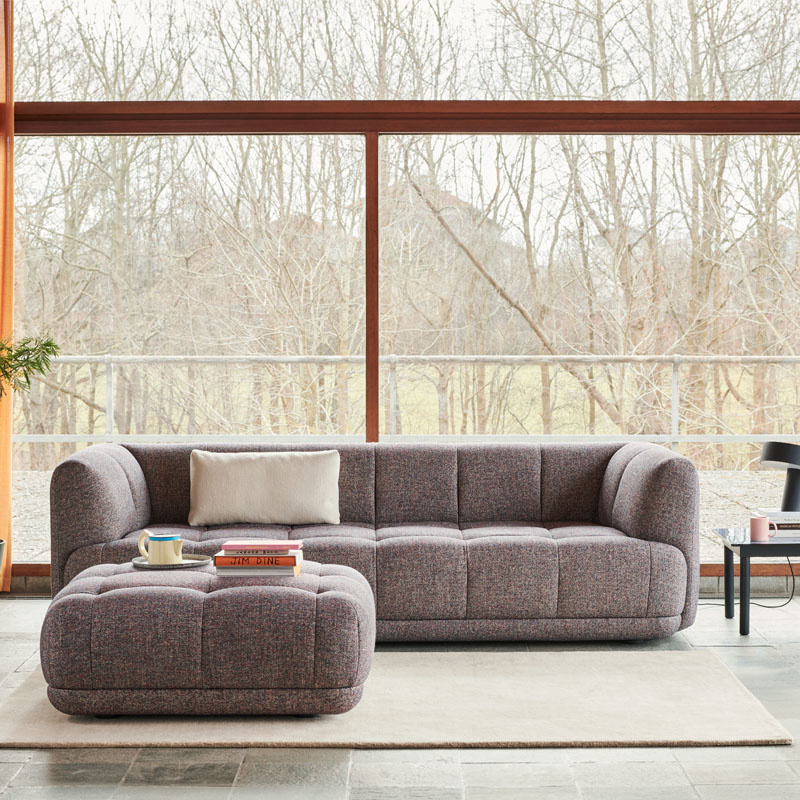
Buying a HAY sofa like Mags, Mags Soft or Quilton starts with precise measuring. Get three things right and you will avoid returns and compromises: your room footprint, the delivery route, and the exact sofa or module dimensions. Below you will find a practical, step by step method to map your space, interpret HAY measurements, and tape out your preferred configuration so you can order with confidence. For a quick primer on proportions, read our sofa size guide.
Start with the right references: room, route and sofa dimensions
You will measure three sets of dimensions: 1) the usable area in your living room, 2) doorways, hallways, stairs and lifts the sofa must pass during delivery, and 3) the sofa or module sizes from the product page. Keep these together in one simple sketch so you can compare and adjust quickly.
Tools you will need
- Measuring tape (5 m or longer) and a laser measure for quick room spans
- Painters tape or newspaper to outline the sofa footprint on the floor
- Pencil and paper or a notes app to save measurements and a quick plan
- A helper for long spans and to simulate movement through the space
- Masking tape for wall markers at seat and arm heights
Step by step: measure your space like a pro
- Measure the room envelope. Take length, width and ceiling height of the living zone, not just the entire room. Note skirting thickness, radiators, sockets and any slopes or beams that could limit placement.
- Locate fixed features. Mark window sills, door swings, fireplace, heaters and built-ins. Measure the distance from these features to nearby walls so you know the true usable footprint.
- Map circulation. Identify the main walkways across the room. Reserve continuous paths that are at least 75 to 90 cm wide so daily movement feels effortless.
- Tape out the sofa footprint. From the product page, note the overall width and depth of your preferred HAY configuration, or the combined width of modules if you are building a sectional. For example, check the exact measurements on the HAY Quilton 3‑seater. Use painters tape to outline the exact outer edge on the floor. Live with it for a day to confirm clearances and flow.
- Account for arms and cushions. The visual mass of arms and back cushions can feel larger than the bare footprint. Add a 5 to 10 cm tolerance around the taped outline to simulate this presence.
- Check sightlines and heights. Measure seat height and back height against TV height, window lines and artwork. Ensure the back will not block a radiator or overlap a sill.
- Place companion pieces. Tape or position your coffee table, side tables and a floor lamp base. Ensure you maintain comfortable reach to the table and adequate walkway around a chaise end or corner.
- Confirm sockets and lighting. Note where you need plug access for lamps or charging. Adjust the layout if the sofa would block essential outlets.
Get the sofa numbers right: interpreting HAY dimensions
On HAY product pages you will find width, depth, height, seat height and seat depth. For modular systems like Mags and Quilton, you will also see individual module widths and depths. For planning, use:
- Overall width and depth for a straight sofa.
- For a corner or chaise configuration, use the long side dimension and the chaise projection to get the full L footprint.
- Seat depth and seat height to anticipate comfort and how much space your knees need relative to the coffee table.
- Arm height to confirm window and radiator clearance.
Check current measurements on the product pages before taping out your plan. For a deep dive into module sizes, see the HAY Quilton overview and sizing, or check the Mags 3‑seater dimensions to compare width and depth in a typical setup.
Measure the delivery route to avoid surprises
A perfect fit in the room still fails if the sofa cannot reach it. Measure every pinch point from the truck to the final spot:
- Front door and internal doors: width and height at their narrowest, including frames and any radiator or cabinet nearby. Measure with doors fully open.
- Hallways and landings: width at the tightest point and the length of straight sections between turns.
- Stairs: stair width, headroom, the depth of landings and the clear diagonal at corners. If there is a tight turn, you may need the sofa length to be shorter than the diagonal turning space.
- Lift: door opening and interior cabin height, width and depth.
- Detachable parts: check if legs or arms can be removed to reduce the carry size. Compare both assembled and packaged dimensions with your route measurements.
Door diagonal rule: compare the packaged sofa height against the door’s diagonal clearance. Door diagonal equals the square root of width² + height². If the packaged diagonal is smaller and you can tilt, it is likely to pass. When in doubt, ask us to confirm packaging sizes for your exact configuration.
Quick clearance guide
| Situation | Recommended measurement | Why it matters |
|---|---|---|
| Main walkway around or beside sofa | 75 to 90 cm | Comfortable daily movement without bumping |
| Sofa front to coffee table | 40 to 50 cm | Easy reach while allowing legroom |
| Space behind sofa to wall | 5 to 10 cm | Skirting clearance and cable access |
| Clearance beside a chaise end | 60 cm minimum | Prevents tight squeeze at the chaise toe |
| Distance from radiators or vents | 10 cm minimum | Airflow and fabric longevity |
Size tips by room shape and layout
Let layout, not just room size, guide your choice. In narrow rooms, a straight Mags or Mags Soft keeps traffic along one side clear. In wider rooms, an L-shaped Quilton can zone the seating from dining. As a rule of thumb, keep the sofa length to roughly two thirds of the wall or zone it sits against so the piece feels anchored without dominating. For small rooms, prioritize seat count over overall length by choosing a chaise to add lounging without extra width. For large rooms, use a corner or U-configuration to create intimacy in an open plan and reserve a 90 cm path behind or beside the set. In very small living rooms, a compact option like the HAY Can Sofa 2‑seater preserves circulation without sacrificing comfort.
Final checks before you order
- Re-measure the taped layout after a day of normal use to confirm flow.
- Save a sketch with all dimensions and module names or codes for your chosen configuration.
- Confirm current assembled and packaged sizes on the product page and ask about removable legs or arms.
- Order fabric swatches so colour and texture match your light and flooring.
- If you are between sizes, choose the smaller when access is tight or the larger when the room is generous and walkways remain 75 cm or more.
FAQs
How do you measure your living room for a couch?
Measure the usable length, width and ceiling height of your seating zone, mark fixed features, reserve a 75 to 90 cm walkway, then tape out the sofa’s full footprint using the exact dimensions from the product page. Live with the outline for a day and adjust before ordering.
What is the 2/3 rule for a sofa?
A practical guideline is to keep your sofa length around two thirds of the wall or zone behind it so the proportions feel balanced. The 2/3 idea also appears with coffee tables, where a table is often about two thirds the sofa length for good reach without crowding.
What is the 2 2 1 rule for sofas?
It describes a common seating plan of two seaters plus two seaters plus one lounge chair to comfortably seat five. In small rooms you can mimic the feel with one 3 seater and two chairs, or a 2.5 seater with a chaise plus one chair to keep circulation open.
How to choose sofa size for living room?
Start with people count, then confirm flow. Choose the smallest configuration that seats your household daily, maintain 75 cm walkways, and apply the two thirds wall rule for balance. For compact rooms pick lower arms and slimmer arms to reduce visual mass.
Do HAY Mags, Mags Soft and Quilton fit small rooms?
Yes, if you select the right combination. Use shorter 1.5 to 2 seat modules or a chaise to gain lounging without extra width. Always tape out the exact module combination you plan to buy and keep walkways clear.
How much clearance do I need for a chaise or corner module?
Keep at least 60 cm beside the chaise toe and 75 cm on the main route around the corner. Maintain 40 to 50 cm between the seat front and coffee table for legroom.
Will my HAY sofa fit through my door?
Measure door width, height and diagonal, then compare with the packaged sofa. If the packaged diagonal is smaller than the door diagonal and legs or arms can be removed, it usually fits. Measure the full route, not just the front door.
Should I leave space behind a sofa?
Yes. Leave 5 to 10 cm to clear skirting and manage cables, and at least 10 cm around radiators or vents for airflow.
Need tailored help?
Bring your room measurements and a quick sketch to our Antwerp showroom and we will help you tape out the ideal HAY configuration and verify access. If you’re hesitating between systems, our HAY Mags vs. Quilton comparison helps you weigh footprints and modules before measuring, or contact us for personal advice. Since 2009, Espoo has guided customers to the right Scandinavian design pieces that fit beautifully and practically.
Recent articles
View all
Coming soon...
Interior design service