
Login
Log in if you have an account
Register
By creating an account with our store, you will be able to move through the checkout process faster, store multiple addresses, view and track your orders in your account, and more.
Create an accountPendant size guide, choose the right diameter
Pendant Light Size Guide
Choosing the right pendant light size is about proportion first, then placement. A pendant that is too small can disappear into the room, while one that is too large can overwhelm the table, island or ceiling height. This guide helps you choose the right diameter, drop height and spacing for real-life situations, whether you want to size pendants over a kitchen island, pick a single statement light for a room, or compare several pendants above a dining table.
If you have ever wondered how to choose pendant light size, how to determine pendant size for kitchen island layouts, or how to pick the right size pendant light for a room, the rules below give you a practical starting point. From there, you can fine-tune based on style, shade shape and how much visual presence you want the fixture to have.
The core rules for pendant light sizing
Most sizing decisions come down to three things: the width of the surface below the light, the size of the room, and the ceiling height. Get those right and the fixture will usually feel balanced.
- For a single pendant in a room, a common rule is to add the room length and width in feet. The total in feet becomes the approximate pendant diameter in inches.
- Above dining tables and kitchen islands, the fixture or group of fixtures should usually cover about 60% to 75% of the surface length.
- Hang pendants about 30 to 36 inches above a dining table or countertop in rooms with standard ceiling height.
- For multiple pendants, keep roughly 24 to 30 inches between fixtures in many standard layouts, then adjust for pendant width and visual weight.
- If ceilings are taller than average, increase the hanging height slightly so the fixture still feels connected to the surface below without crowding the view.
These rules are not strict design laws, but they work well as a dependable pendant light size chart in practice.
How to choose the right pendant light size for a room
If you are choosing one pendant for a whole room rather than above a table or island, start with the room dimensions. Measure the room length and width, add them together in feet, and use that number as a guide for the fixture diameter in inches.
For example, a room that is 12 feet by 10 feet gives you 22. That means a pendant around 22 inches wide is often a good visual fit. In a 16 by 14 foot room, a fixture around 30 inches wide will usually feel more proportional.
This approach works especially well in entryways, bedrooms, living rooms and open areas where the pendant is read in relation to the whole space. It is less useful when the pendant is anchored above furniture, because then the furniture becomes the main reference point.
Also consider visual density. An open wire frame pendant looks lighter than a solid opaque dome of the same diameter. So if you are deciding how to choose the right size pendant light, remember that material and silhouette affect perceived size just as much as the measurement itself.
Pendant light size guide by fixture category
One easy way to narrow your choice is to think in size families. This is especially helpful when browsing design collections with the same model available in several diameters.
| Fixture size | Typical diameter | Best use |
|---|---|---|
| Mini pendant | Up to 10 in / 25 cm | Hallways, bedside use, narrow counters, grouped installations |
| Small pendant | 10 to 15 in / 25 to 38 cm | Kitchen counters, smaller tables, pairs or trios over islands |
| Medium pendant | 15 to 20 in / 38 to 50 cm | Standard dining tables, larger counters, statement singles in modest rooms |
| Large pendant | 20 to 30 in / 50 to 76 cm | Dining tables, living areas, open spaces, bold focal points |
| Extra-large pendant | 30 in / 76 cm and up | Double-height spaces, large rooms, oversized feature lighting |
On Espoo, several pendant lamps models are available in multiple sizes, which makes this kind of category thinking especially useful. A compact pendant can work beautifully in series above a counter, while a larger version of the same design may suit a dining table or broader surface much better.
How to determine pendant size for kitchen island layouts
Kitchen islands are one of the most common sizing challenges. People often ask how to determine size of pendant lights over island setups because the answer depends on both island length and how many fixtures you want to hang.
Start by deciding whether you want one linear fixture, two larger pendants or three smaller pendants. In most kitchens, the combined width of the pendants should fill around 60% to 70% of the island length. That creates presence without making the installation feel cramped.
As a rough guide:
- Small islands often suit 1 larger pendant or 2 compact pendants.
- Medium islands often suit 2 medium pendants or 3 slim pendants.
- Long islands often suit 3 pendants or a linear pendant.
If you want a quick formula for how to size pendants over island surfaces, divide the island width by about 5 to estimate a comfortable pendant diameter. This is not the only method, but it is a helpful sense check.
For example, if your island is 40 inches wide, a pendant around 8 inches wide may feel elegant and light in a multiple-pendant layout, while a larger diameter may work if you use fewer fixtures and want a stronger statement.
How many pendants over an island?
The number of pendants depends mainly on island length and fixture width. In many homes, these ranges work well:
- Up to about 5 feet: 1 large pendant or 2 small pendants
- 5 to 7 feet: 2 pendants
- 7 to 9 feet: 2 or 3 pendants
- 10 feet and longer: 3 pendants or 1 linear fixture
If you are unsure how to determine pendant size over island designs with seating, leave enough open sightlines across the kitchen. Oversized shades can look beautiful, but they should not block conversation or make the island feel visually heavy.
Spacing pendant lights over a kitchen island
If you are trying to work out how to measure pendant lights over island layouts, start from the center line of the island. Spacing is usually measured center to center.
A practical method is:
- Leave about 6 to 12 inches from the outer edge of the island to the outside edge of the nearest pendant.
- Position the remaining pendants so spacing appears even.
- In many layouts, keep about 24 to 30 inches between pendant centers, then adjust if the shades are especially wide or narrow.
A good visual rule is that the gap between pendants should not feel smaller than the width of the fixture itself. If the shades almost touch visually, the installation usually needs either fewer pendants or smaller ones.
How high to hang pendants over a kitchen island
For standard ceilings, hang the bottom of the pendant about 30 to 36 inches above the countertop. This gives useful task light without placing the fixture too low in your line of sight.
With higher ceilings, you can raise the pendants slightly. A common rule is to add about 3 inches of extra hanging height for each additional foot of ceiling height above 8 feet. The exact result depends on the scale of the pendant and the openness of the kitchen, but this rule keeps the drop visually proportional.
How to size pendant lights above a dining table
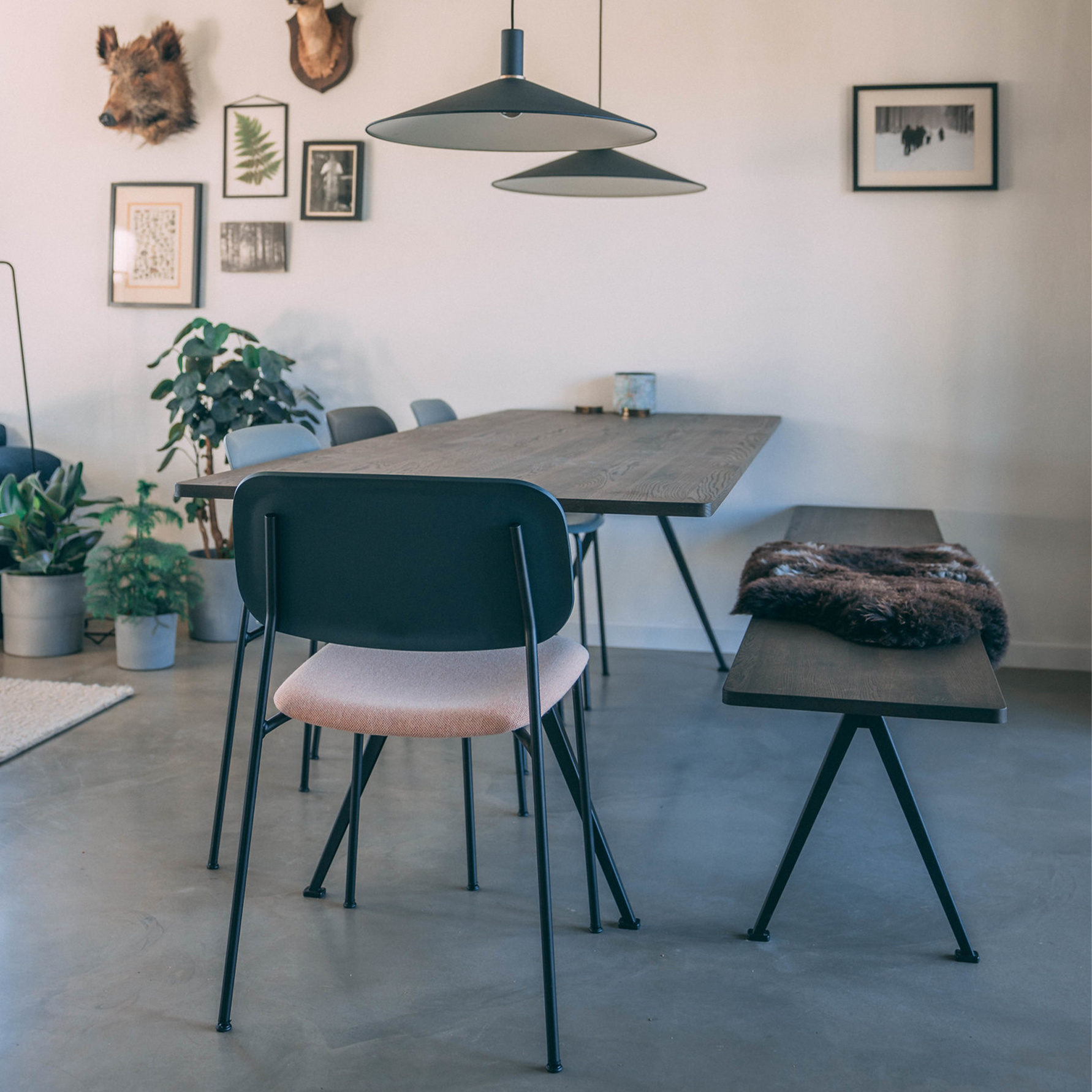
A dining table gives you a clear frame of reference, which makes sizing easier than in a free-floating room. In most cases, the ideal pendant or pendant group should be narrower than the table so the light feels centered and controlled.
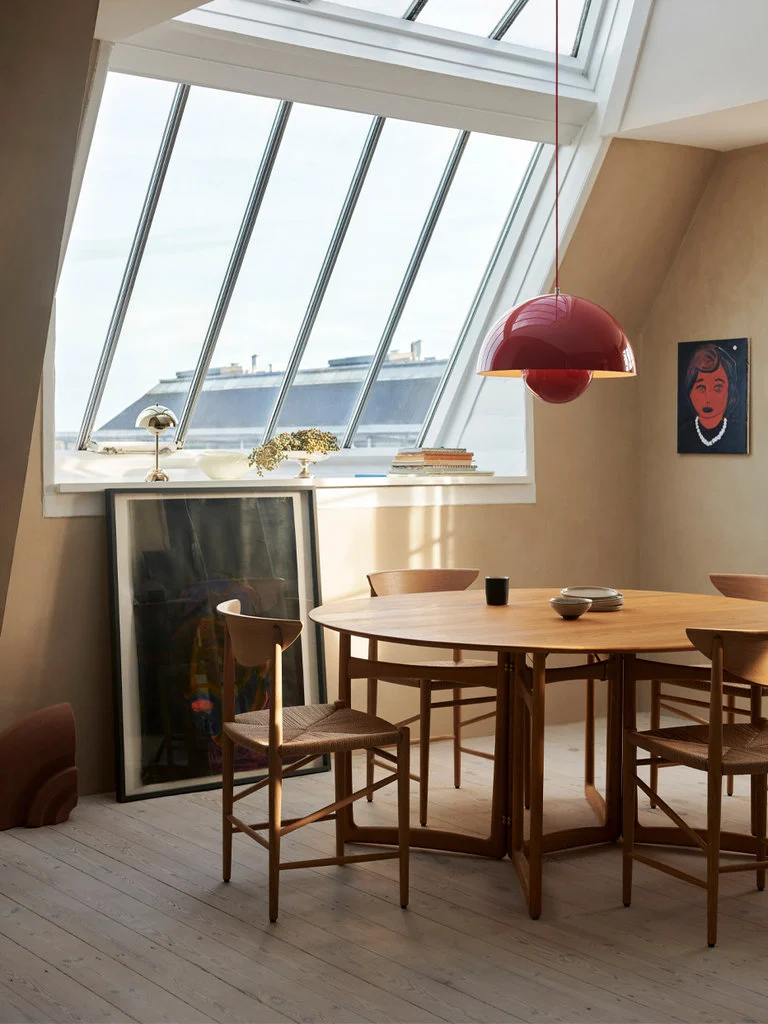
For a single pendant, a good rule is to choose a diameter that is about one-half to two-thirds of the table width. For longer tables, two pendants or one linear pendant often create better balance than one central fixture.
Another useful guide is that the overall fixture width should be around 60% to 75% of the table length. This keeps the light visually connected to the table rather than the entire room.
| Table type | Recommended approach |
|---|---|
| Round table | 1 central pendant, sized in proportion to table diameter |
| Small rectangular table | 1 medium pendant or 2 compact pendants |
| Long rectangular table | 2 pendants or 1 linear pendant |
| Large statement table | 1 oversized pendant, 2 large pendants or a long linear fixture |
Dining table hanging height
In most homes, the bottom of the pendant should sit about 30 to 36 inches above the tabletop. This height is low enough to create intimacy and focus, yet high enough to keep sightlines comfortable across the table.
If the pendant is very tall or visually dense, it can help to hang it slightly higher. If the shade is shallow and airy, you can often stay closer to the lower end of the range.
Single pendant vs multiple pendants
If you are wondering how to pick island pendant size or whether one large pendant is better than several smaller ones, think about light distribution and visual rhythm.
A single pendant creates a clean focal point. It works well above round tables, in entryways and in rooms where you want one sculptural object to lead the design.
Multiple pendants spread light more evenly and often suit longer surfaces better. They can also feel lighter visually, because each fixture is smaller even though the total installation spans more width.
- Choose a single pendant when the furniture below is compact or central.
- Choose multiple pendants when the surface is long and you need more even coverage.
- Choose a linear pendant when you want the simplicity of one fixture with the reach of several lights.
Pendant height by ceiling height
Diameter is only half of the equation. Hanging height changes how large a pendant feels and how well it works in daily use. A pendant can be the right width but still look wrong if it hangs too high or too low.
| Ceiling height | Typical guidance above table or island |
|---|---|
| 8 ft | 30 to 36 in above the surface |
| 9 ft | 33 to 39 in above the surface |
| 10 ft | 36 to 42 in above the surface |
| 11 ft+ | Adjust by scale, sightlines and fixture height |
In open rooms with tall ceilings, larger pendants usually feel more natural because the extra air around them reduces their visual dominance. In lower rooms, compact pendants or shallower shades often create a cleaner result.
Can a pendant light be too big?
Yes, but "too big" is usually about proportion, not absolute size. A large pendant can look stunning if it is scaled to the room, furniture and ceiling height. Problems start when the fixture blocks views, hangs too low, extends too close to the table edge, or dominates the room without enough negative space around it.
Signs a pendant is too big include:
- It visually overpowers the table or island beneath it.
- There is not enough clearance around people moving through the space.
- The pendant feels heavy or crowded compared with the ceiling height.
- Multiple pendants look compressed because each fixture is too wide for the available span.
That said, oversized pendants can work beautifully in contemporary interiors, especially when the shape is simple and the room has enough openness to support it.
What is a good size for a pendant?
A good size for a pendant is one that looks clearly related to the surface below or the room around it. For small counters, narrow hallways and grouped installations, compact pendants often work best. For dining tables and islands, medium sizes are usually the most versatile. For large open rooms or statement dining areas, large pendants can create the right visual anchor.
In practical terms, many people end up choosing:
- 10 to 15 inches for compact or repeated pendants
- 15 to 20 inches for versatile everyday pendants
- 20 inches and above for bold focal pendants
The best answer still depends on what the pendant is lighting and how you want the room to feel.
Shade shape affects perceived size
Two pendants with the same diameter can look completely different once shape is involved. This matters when you are deciding how to choose pendant light size from product photos alone.
- Globe pendants tend to look soft and full, so they feel visually present.
- Cone or tapered pendants often look lighter and direct more focused task light downward.
- Drum or dome pendants can feel broader and more architectural.
- Linear pendants are ideal when width matters more than visual depth.
- Transparent glass shades often read lighter than solid metal or opaque shades of the same size.
This is why a compact technical pendant may work well in series above a counter, while a larger fabric, paper or metal shade suits a dining setting better even if the measurements are only moderately different.
Real-world sizing examples
These examples help translate the formulas into practical choices.
Example 1: kitchen island
Your island is 240 cm long and 95 cm wide. You want multiple pendants rather than a linear fixture. Two medium pendants may look a bit sparse over that length, so three smaller pendants can create better rhythm. Keep the outer pendants inset from the edges and aim for even center-to-center spacing. If the pendants are visually solid, choose a slightly smaller diameter to avoid crowding.
Example 2: dining table
Your dining table is 200 cm long. A fixture span of roughly 120 to 150 cm will usually feel balanced. That could mean two pendants around 30 to 40 cm each, depending on shape, or one linear pendant shorter than the table length.
Example 3: entry or bedroom
Your room is 3.5 by 4 metres. Converted loosely to the standard room formula, a medium pendant often lands in the right range. If the fixture is decorative and airy, you may size up a little. If it is dense and opaque, staying closer to the core formula usually works better.
How this helps when shopping pendant lights at Espoo
Espoo offers pendant lights from design brands in a wide range of diameters and formats, which makes these sizing rules especially useful during product selection. Some models are available in several sizes, so the same design can suit very different spaces.
For example, a compact pendant can work above a hallway console or in series over a kitchen counter, while a larger version may be more suitable above a dining table. Linear pendants can be a smart solution when you want broad table coverage with one clean fixture. Some product pages also indicate whether a pendant suits smaller tables, kitchen counters or larger surfaces, which can help confirm your sizing direction.
When comparing options, check these specifications first:
- Diameter or total width
- Fixture height
- Cable or suspension length
- Whether height is adjustable
- Recommended use above counters, tables or in series
If you want to explore a wider lighting collection beyond pendants, it can also help to compare how different fixture types handle scale, spread and visual weight in a room.
FAQ about pendant light sizing
What are the rules for pendant lights?
The main rules are simple: size the pendant in proportion to the room or surface below it, hang it about 30 to 36 inches above tables and countertops in standard-height rooms, and keep spacing even when using multiple pendants. For whole-room sizing, use the room length plus width in feet as a starting point for fixture diameter in inches.
How do I choose the right size pendant light?
First decide what the pendant relates to most: the room, a dining table, or a kitchen island. Then use the right reference. For rooms, use the room-dimension formula. For tables and islands, size the fixture in relation to the furniture width and length. Finally, adjust for shade shape, ceiling height and how bold you want the light to feel.
How to determine pendant size for kitchen island layouts?
Measure the island length and width, decide how many pendants you want, and aim for a total fixture span of about 60% to 70% of the island length. Then leave enough edge clearance and even spacing between pendants. In many kitchens, two or three pendants work best depending on island size.
How to measure for pendant lights over kitchen island surfaces?
Measure the island length first. Next, decide where the outer pendants should sit so they are not too close to the edges. Then divide the remaining span evenly for the number of pendants you want. Measure center to center when laying out the electrical points.
What is a pendant light size chart useful for?
A pendant light size chart helps you compare room size, table size, pendant diameter and hanging height quickly. It is especially useful when you are choosing between several fixture sizes online and want a practical reference before committing to one model.
Is a 2.5 inch pendant big?
No, a 2.5 inch pendant is very small by most residential standards. That size would usually be considered miniature and is more likely to be used as a decorative accent, part of a clustered fixture, or in a very specialised application rather than as a standard main pendant.
Can I use oversized pendants over an island?
Yes, as long as the island is large enough and the pendants do not block views or feel cramped. Oversized pendants often work best when you use fewer fixtures, such as two bold pendants instead of three medium ones.
Should pendant spacing match the pendant width?
That is a useful visual rule. In many layouts, spacing that is close to the pendant width creates a balanced rhythm. It is not exact in every case, but it is a good check if your layout feels too tight or too spread out. For related planning decisions, see this guide to a lighting plan for your home.
Recent articles
View all
Coming soon...
Interior design service